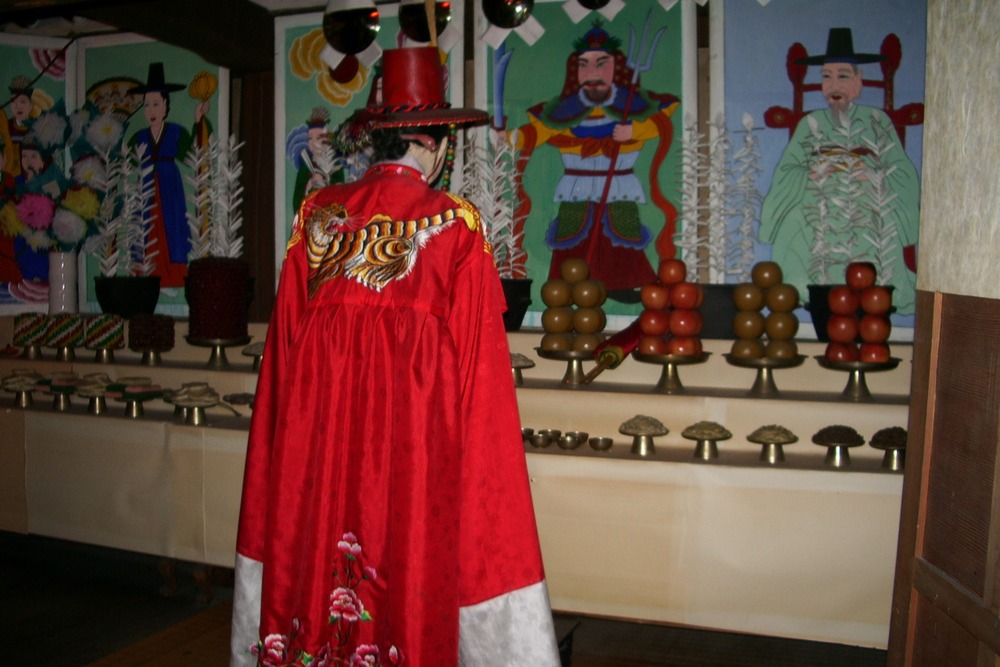
What does the future hold? Korea has been answering that question for thousands of years — and it uses two very different tools to do it.
Whether you’ve stumbled across a TikTok about your Four Pillars chart or watched a Korean drama where a mudang (shaman) sends chills down a character’s spine with an eerily accurate reading, you’ve probably wondered: what’s the actual difference between these two systems?
Both Bazi (사주, Saju) and Korean Shamanic Reading (Sinjeom, 신점) have guided Koreans through life’s biggest decisions for millennia — marriage, career pivots, moving abroad, family crises. Yet they operate from completely different philosophical universes.
One is structured, data-driven, and almost mathematical. The other is raw, intuitive, and channels forces beyond the rational mind.
Let’s break both down — and figure out which one might actually speak to you.
Bazi: Your Life as a Cosmic Blueprint
Think of Bazi as the astrology of East Asia, but with more math.
Your exact birth year, month, day, and hour are converted into eight Chinese characters (hence the name Four Pillars of Destiny — four pillars, two characters each). These eight characters represent the elemental energies present at the moment you entered the world, and Bazi practitioners use them to map the large-scale patterns of your life.
It’s a Weather Map, Not a Crystal Ball
Here’s the analogy Korean Bazi masters often use: your chart doesn’t tell you exactly what will happen. It tells you what seasons you’ll move through.
Some decades bring relentless rain — financial pressure, health challenges, relationship strain. Others bring clear skies and tailwinds where almost everything you touch succeeds. Knowing which season is coming lets you plant the right seeds at the right time, or batten down the hatches before the storm arrives.
This is why serious Bazi readings require one thing above all else: your precise birth time. Without it, the practitioner is working with an incomplete map.
The Parallel Lives Phenomenon
One of the most compelling arguments for Bazi’s validity is something Korean researchers have informally documented for years: people born at the same time, in completely different circumstances, often hit the same life milestones at the same age.
Career peaks at the same decade. Health crises in the same five-year window. Major relationship shifts at nearly identical ages. The environment and choices differ wildly — but the timing of life’s turning points echoes across unconnected individuals. Bazi sees this as evidence that we’re each navigating a shared cosmic rhythm.
The Twin Paradox (And How Bazi Explains It)
The most common challenge thrown at Bazi: “If it’s so accurate, why do twins live completely different lives?”
Bazi has a surprisingly technical answer. In the Four Pillars system, the Daewun (대운) — the 10-year luck cycle that governs major life phases — can run in opposite directions depending on the order of birth and gender. So while twins share the same cosmic DNA, one may experience life’s major phases in a forward sequence and the other in reverse. Same blueprint, mirrored journey.
Where Bazi Falls Short
Bazi is brilliant at macro-level pattern recognition. It will tell you that your late 30s are a period of expansion, or that your mid-40s carry financial risk. But if you want to know “Should I accept this specific job offer on Thursday?” — Bazi gives you the weather forecast, not the traffic report.
Korean Shamanic Reading: When the Spirits Speak
If Bazi is structured and analytical, Sinjeom is its complete opposite — and that’s precisely the point.
A Korean mudang (무당) doesn’t ask for your birthday. They don’t need your name. What they’re accessing isn’t a database — it’s a living connection to unseen forces: ancestral spirits, deities, and the energetic imprint of your current circumstances.
No Data Required
This is the detail that tends to make skeptics lean forward: a skilled mudang will often describe your current situation — family dynamics, suppressed emotions, specific objects in your home — without you having said a word.
The mechanism, in traditional Korean spiritual understanding, is twofold:
- Hwagyeong (화경) — a kind of “spiritual mirroring” where the practitioner sees your situation reflected as images or visions
- Direct transmission — the deity or spirit they serve whispers specific information directly
The closest Western equivalent would be a psychic medium, but the cultural and ritual framework in Korean shamanism is far more elaborate and embedded in centuries of practice.
The Power Is in the Devotion
Here’s what separates a genuine mudang from a fraud, according to the tradition itself: not how much they’ve studied, but how deeply they’ve devoted themselves.
Daily prayer, ritual offerings, spiritual discipline — these are what sharpen a shaman’s “antenna.” Their accuracy is a function of their spiritual frequency, not their intellectual knowledge. This is a fundamentally different model of expertise than anything the Western world tends to recognize.
Uncanny with the Past, Variable with the Future
Ask anyone who has had a memorable shamanic reading and they’ll likely tell you the same thing: the past accuracy was stunning.
“She described exactly what was hidden in my grandmother’s drawer.” “He knew about a rift in my family that happened before I was born.” This kind of hyper-specific, verifiable accuracy about past events is where Korean shamanic readings build their reputation.
The future is a different story. Predictions vary across practitioners and — crucially — across the choices the individual makes going forward. The future, in the shamanic worldview, is not a fixed destination. It’s a probability field that shifts with every decision.
Fate vs. Free Will: The Question Both Systems Are Really Answering
At this point, you might be wondering: if everything is mapped out, what’s the point of knowing?
This is where both traditions converge on something genuinely profound.
Neither Bazi nor Korean shamanic reading exists to tell you to sit down and accept your fate. Quite the opposite.
“The future is never set in granite.”
Bazi tells you the seasons so you can choose wisely within them. Shamanic readings identify current spiritual blockages so you can clear them. The entire enterprise of Korean fortune-telling — across both traditions — is oriented toward active navigation, not passive resignation.
If the future were 100% fixed, none of this would matter. You can’t “prepare” for a mathematical certainty. The fact that people seek these readings at all — and that the traditions counsel specific actions, rituals, and changes — is itself an argument for free will embedded within fate.
Perhaps we seek to know our destiny precisely because, somewhere deep down, we already know we have the power to shape it.
So Which One Should You Try?
Here’s a practical breakdown:
| Bazi | Korean Shamanic Reading | |
|---|---|---|
| What you need | Exact birth date & time | Nothing — just yourself |
| Best for | Long-term planning, career timing, relationship compatibility | Current blockages, ancestral issues, urgent decisions |
| Timeframe | Decade-level cycles | Present moment + near future |
| Mechanism | Structural / analytical | Intuitive / channeled |
| Western equivalent | Detailed natal astrology | Psychic mediumship |
| Consistency | High (same chart, same reading) | Varies by practitioner |
If you’re a planner who wants a long-range map of your life’s rhythms, start with Bazi.
If you’re navigating something urgent and feel like there’s a dimension to your situation that logic isn’t touching, a trusted shamanic reading might be exactly what you need.
And if you’re genuinely curious? Try both. They don’t compete — they complete each other.
Have you experienced either Bazi or a Korean shamanic reading? What was it like? Share in the comments below — I’d genuinely love to hear your story.
Tags: Korean spirituality, Bazi, Four Pillars of Destiny, Korean shamanism, mudang, sinjeom, fortune telling, Korean culture, fate and free will, spiritual wellness