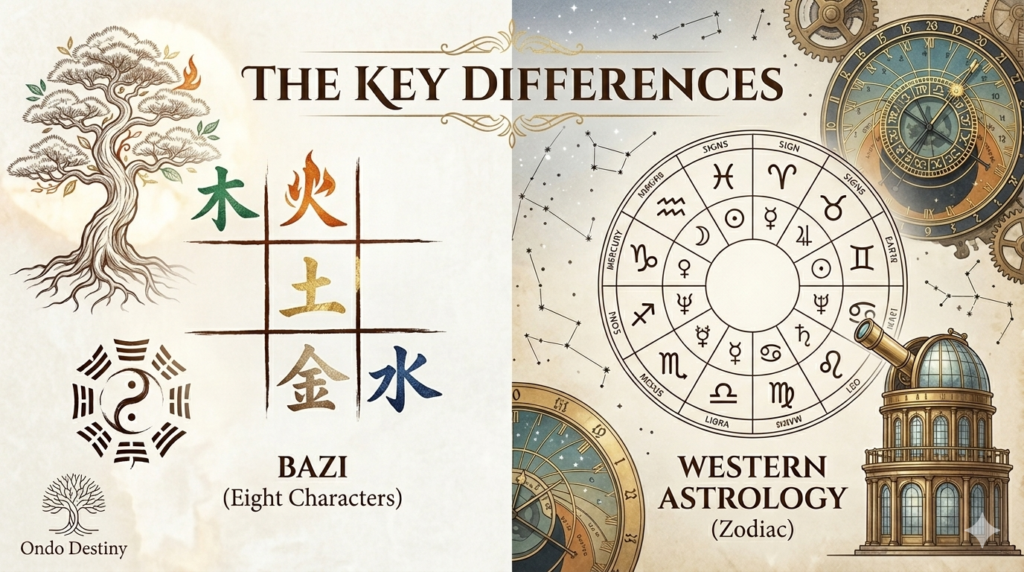
If you have ever wondered how BaZi compares to Western astrology — you are not alone.
Both systems have captivated millions of people for thousands of years. Both seek to answer the same fundamental questions: Who am I? Why am I here? What does my future hold?
But the way they answer these questions could not be more different.
What is Western Astrology?
Western astrology is a system of divination based on the positions of the sun, moon, and planets at the moment of your birth. The most familiar element is the Sun Sign — the zodiac sign determined by the position of the sun on your birthday. There are twelve sun signs, from Aries to Pisces, each associated with specific personality traits and life themes.
Beyond the sun sign, Western astrology also considers the Rising Sign (Ascendant) — how you appear to others — the Moon Sign, your emotional inner world, the positions of all planets across twelve houses, and the aspects between planets. A complete Western astrology birth chart is a rich and complex map of celestial influences at the moment of your birth.
What is BaZi?
BaZi — also known as the Four Pillars of Destiny — is a system of destiny analysis based on the Chinese calendar system. Rather than looking at the positions of celestial bodies, BaZi works with the specific combination of year, month, day, and hour of your birth — each represented by a Heavenly Stem and an Earthly Branch.
The result is your unique set of eight characters — your BaZi chart — which reveals your personality, strengths, challenges, and the unfolding rhythm of your life through time.
Key Differences: BaZi vs Western Astrology
| Western Astrology | BaZi | |
|---|---|---|
| Foundation | Positions of celestial bodies at birth | Chinese lunisolar calendar cycles |
| Core Identity | Sun Sign | Day Master (日主) |
| Personality Types | 12 sun signs | 10 Day Masters — millions of unique chart combinations |
| Time Cycles | Planetary transits and progressions | 10-year Luck Pillars + annual luck cycles |
| Compatibility | Sun sign synastry | Elemental interaction between complete charts |
| Cultural Roots | Ancient Babylon, Greece, and Rome | Ancient China and Korea — Taoism, Confucianism, I Ching |
Which System is More Accurate?
This is perhaps the most common question — and the most difficult to answer.
The truth is that both systems offer profound insights when applied by a skilled practitioner. Both have produced remarkably accurate readings that have changed people’s lives.
Rather than asking which system is more accurate, a better question might be: which system resonates most deeply with you?
Some people find that Western astrology’s emphasis on planetary symbolism and mythology speaks to their soul. Others find that BaZi’s elemental logic and practical life mapping feels more concrete and actionable. Many serious students of destiny arts study both — finding that each system illuminates different aspects of the human experience.
Can You Use Both BaZi and Western Astrology?
Absolutely. Many modern practitioners combine insights from both systems, using Western astrology for psychological depth and BaZi for practical life timing and destiny mapping. There is no rule that says you must choose one over the other. The goal of any destiny system is self-understanding — and the more tools you have for that journey, the better.
Conclusion
BaZi and Western astrology are two of humanity’s most enduring attempts to understand the mystery of who we are and why we are here. Both systems honor the profound connection between the moment of our birth and the unfolding of our lives. Both offer genuine wisdom for those willing to explore them with an open mind.
Whether you are drawn to the celestial poetry of Western astrology or the elemental precision of BaZi — or both — the journey of self-discovery is always worth taking.
Because knowing yourself is the beginning of all wisdom.
Curious about your own BaZi chart? Try our Free BaZi Calculator — generate your complete Four Pillars instantly, no signup required.
