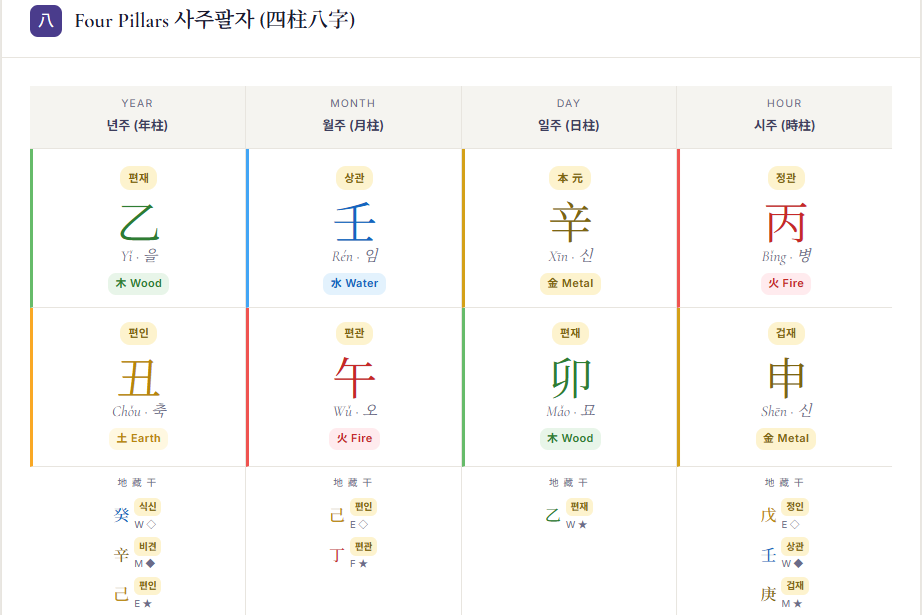
So you have heard about BaZi — the ancient art of Four Pillars of Destiny — and you want to know how to read your own chart. You have come to the right place.
In this complete beginner’s guide, we will walk you through everything you need to know to understand your BaZi chart — from generating it for the first time to understanding what each part means.
What You Need to Get Started
To generate your BaZi chart, you will need your exact date of birth (day, month, year), your exact time of birth (as precise as possible), and your place of birth (for time zone adjustment).
The time of birth is particularly important in BaZi, as it determines your Hour Pillar — one of the four key pillars of your chart. If you do not know your exact birth time, you can still read a partial chart using only your year, month, and day of birth.
Step 1: Generate Your BaZi Chart
The first step is to calculate your Four Pillars chart. You can do this using a BaZi calculator — simply enter your date and time of birth to generate your eight characters.
Your chart will display four pillars, each consisting of two characters:
| Pillar | Heavenly Stem | Earthly Branch | Represents |
|---|---|---|---|
| Year 年柱 | Year Stem | Year Branch | Ancestry, early childhood, social environment |
| Month 月柱 | Month Stem | Month Branch | Career, education, middle years of life |
| Day 日柱 | Day Stem ← YOUR DAY MASTER | Day Branch | Adult self, marriage, core identity |
| Hour 時柱 | Hour Stem | Hour Branch | Later years, children, deepest aspirations |
Step 2: Identify Your Day Master
The single most important character in your entire BaZi chart is your Day Master — the Heavenly Stem of your Day Pillar.
Your Day Master represents your core identity — who you are at your deepest level. It is the lens through which all other elements in your chart are interpreted.
| Day Master | Symbol | Image |
|---|---|---|
| Yang Wood | 甲 | The Oak Tree |
| Yin Wood | 乙 | The Vine |
| Yang Fire | 丙 | The Sun |
| Yin Fire | 丁 | The Candle |
| Yang Earth | 戊 | The Mountain |
| Yin Earth | 己 | The Soil |
| Yang Metal | 庚 | The Sword |
| Yin Metal | 辛 | The Jewel |
| Yang Water | 壬 | The Ocean |
| Yin Water | 癸 | The Rain |
Once you know your Day Master, you have the foundation for understanding your entire chart.
Step 3: Identify Your Elements
The next step is to identify which of the Five Elements appear in your chart — and in what quantity. Count how many times each element appears across all eight characters of your chart.
What does your elemental balance mean?
- Strong elements (appearing 3+ times) represent your natural strengths, dominant personality traits, and areas where energy flows easily.
- Weak or absent elements represent areas of challenge, blind spots, or qualities you may need to consciously develop.
Step 4: Find Your Useful God (用神)
In BaZi, the Useful God (Yong Shen) is the element that your Day Master needs most — the element that brings your chart into balance.
Finding your Useful God is one of the most important steps in BaZi reading, as it reveals the types of environments where you naturally thrive, the careers and industries best suited to your chart, the qualities to cultivate in yourself and seek in others, and the colors, directions, and activities that support your energy.
Step 5: Read Your Ten Gods (十神)
The Ten Gods are the relationships between your Day Master and every other character in your chart. They reveal how different energies function within your specific chart.
| Ten God | Chinese | Represents |
|---|---|---|
| Friends | 比肩 | Your peers and allies |
| Rob Wealth | 劫財 | Your competitors |
| Eating God | 食神 | Creative expression, talent |
| Hurting Officer | 傷官 | Unconventional expression |
| Indirect Wealth | 偏財 | Opportunistic wealth |
| Direct Wealth | 正財 | Structured wealth |
| Seven Killings | 七殺 | Pressure, ambition, challenge |
| Officer | 正官 | Authority, discipline, recognition |
| Indirect Resource | 偏印 | Intuition, hidden wisdom |
| Direct Resource | 正印 | Support, learning, nourishment |
Each of these gods plays a different role in your life depending on where they appear in your chart and how strong they are.
Step 6: Understand Your Luck Pillars (大運)
Your BaZi chart is not static — it unfolds through time via your Luck Pillars (大運), which change every ten years throughout your life.
Each Luck Pillar introduces a new set of elemental energies that interact with your natal chart, creating different opportunities and challenges during that decade. Understanding your current Luck Pillar is essential for timing major life decisions — career changes, relationships, investments, and personal growth.
Step 7: Consider the Annual Luck
In addition to your ten-year Luck Pillars, each calendar year brings its own energy that interacts with your natal chart. This is why BaZi readers produce annual forecasts — to help you understand how the energy of each year will specifically affect your unique chart.
How Deep Does BaZi Go?
The seven steps above are just the beginning. A complete BaZi reading can take years of study to master fully. Advanced BaZi analysis includes special structures and formations, clash, combination, and punishment interactions between branches, the hidden stems within each branch, month and day luck interactions, and chart strength assessment.
But you do not need to master all of this to begin your BaZi journey. Start with your Day Master, explore your elemental balance, and let your understanding deepen naturally over time.
Conclusion
Reading your BaZi chart is one of the most profound journeys of self-discovery you can undertake. Each layer you uncover reveals something new about who you are, why you are the way you are, and what your unique path in life may look like.
The chart does not define you. It simply reflects you — and in that reflection, you may find a deeper understanding of yourself than you ever thought possible.
Your destiny is not written in stone. It is written in the stars — and it is yours to explore.
Ready to begin? Try our free BaZi calculator at Ondo Destiny — generate your complete Four Pillars chart instantly, no signup required.
